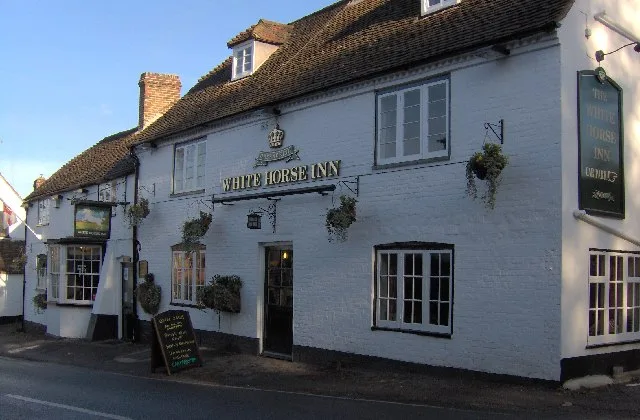

Droxford's Grade II listed White Horse Inn was approved for conversion to three houses on 12 August, after three years on the market and no community bid.
The White Horse Inn at Droxford will be converted into three houses. Winchester City Council’s planning committee approved both the change of use and the listed building consent on 12 August, and the South Downs National Park Authority’s register records both decisions as approved and issued that day, under references SDNP/25/02601/FUL and SDNP/25/02602/LIS.
The applicant is Droxford Property Developments Ltd. The scheme turns the Grade II listed pub and its rear outbuilding into two three-bedroom houses and one four-bedroom house, keeping the existing access off South Hill, with parking and landscaping. It went to committee only because Droxford Parish Council asked for it to, citing the loss and harm to heritage.
Three years on the market, and no community bid
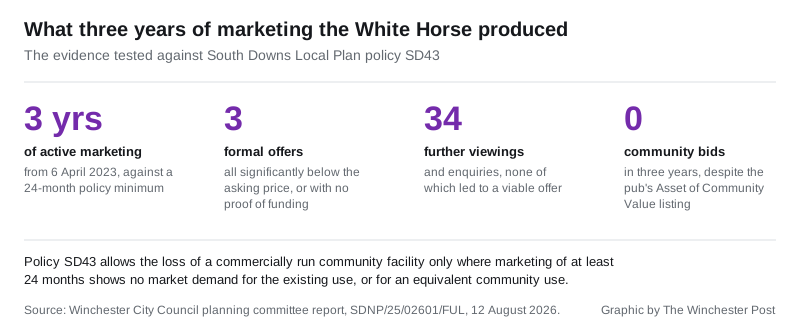
The pub sits inside the South Downs National Park, so the application was judged against the South Downs Local Plan rather than Winchester’s own. Policy SD43 protects community facilities, and for a commercially run one like a pub it allows the loss only where there is “evidence … of a robust marketing campaign of at least 24 months that clearly demonstrates there is no market demand for the existing use or an equivalent community use”.
The officer’s report to committee sets out what the marketing produced. Formal marketing began on 6 April 2023 and was still running, well past the 24-month minimum. It was handled by Everard Cole Ltd, a national consultancy specialising in licensed and hospitality premises, and used Rightmove, Daltons, Movehut and its own website, plus email campaigns to buyers within a 50-mile radius, a for-sale board and a virtual tour. Three formal offers came in, all either significantly below the asking price or without proof of funding. A further 34 viewings and enquiries produced nothing viable.
The White Horse is also on the council’s list of Assets of Community Value, which gives a community group a window to prepare its own bid when a listed asset goes up for sale. The report records the position bluntly: the pub “has been up for sale for 3 years and there have not been any bids from the community in that time”.
The heritage harm the council accepted
Getting the layout to work meant demolishing the rear section of the listed building known as the skittle alley. The council’s historic environment officer concluded that removing it results in “less than substantial harm”, a term of art in planning that still requires the harm to be weighed against public benefits, and separately raised concerns about losing a public house from the conservation area. The report says that officer “was not fully in support of the proposed change of use being the best use of the building in the context of the character of the conservation area”, and that a planning balance had to be struck between the harm and bringing the building back into use. Rather than object outright, the officer asked for five conditions on the listed building consent.
Droxford Parish Council’s objection on the amended plans, dated 22 May 2026, is unusually even-handed. It accepted that the revised scheme improved the site layout, amenity space and parking, and acknowledged that conservation officers considered the skittle alley to be of more limited historic significance. It still regretted “the loss of the public house use and the associated impact on the character of the conservation area”, and asked for the decision to be taken by committee rather than by an officer.
On the original proposal the parish council had gone further, raising highway safety on South Hill, which forms part of the A32 through the village, where it said visibility at the access is limited and the road narrows with intermittent footways. Hampshire County Council as highway authority raised no objection, subject to an informative about a dropped kerb, having reviewed personal injury data for the 2019 to 2023 period. The parish council also questioned whether a small rural village’s infrastructure could take three large dwellings.
Three residents objected, from addresses within the Winchester City Council area. Their points ranged from traffic, parking and overlooking to the view that the building should return to being a pub. One objector took the opposite line, saying the previous owners had left it in such a poor state that reviving it commercially was unrealistic, and welcomed the restoration.
What happens to the building
Few external alterations are proposed, because of the Grade II listing: the front facade stays as it is. The application had a long run-up, including a stage 2 pre-application in 2025 for a five-dwelling scheme, and an earlier five-house proposal in 2017 that was withdrawn. Conditions cover drainage for foul and surface water, additional ecological enhancements, and hard and soft landscaping and boundary treatments.
What it means for you
Droxford loses a pub permanently. The village is not left without one: the Bakers Arms on the High Street is still listed as a trading pub on the Food Standards Agency register, rated 4 at its inspection on 4 March 2025. The White Horse does not appear on that register at all, consistent with it having stopped trading.
If your village is facing the same question about a local pub, the mechanics here are worth knowing. An Asset of Community Value listing does not stop a sale or a change of use; it buys a community group time to raise money and bid. In Droxford’s case nobody did over three years, and that absence of a bid became part of the evidence the council relied on.
The route the parish council used is also available to any parish: asking for an application to be determined by the planning committee rather than by officers. It did not change the outcome here, but it did put the decision, the objections and the officer’s reasoning on the public record.
Applications inside the national park, which covers Droxford and much of the Meon Valley, are decided by Winchester’s committee but recorded on the South Downs National Park Authority register rather than the city council’s. If you are looking for a case in one of those villages and cannot find it, that is why. We keep the district’s bigger decisions on our Winchester planning news page.
Have your say