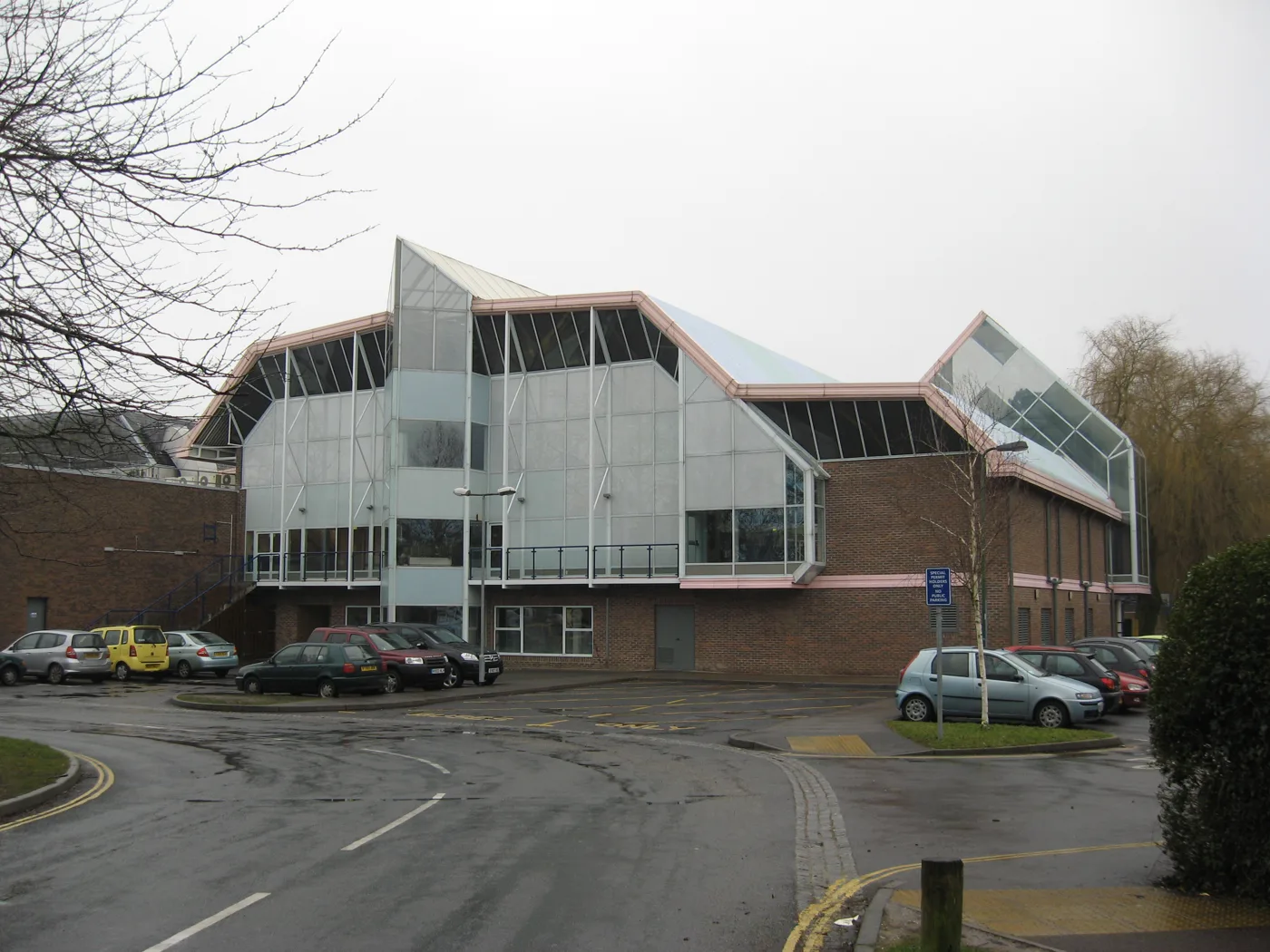

Cabinet chose Sea Lanes for the old River Park leisure centre on 9 September. Only one bid met the council's own deadline, and the highest offer was rejected.
Winchester will get an outdoor lido on the site of its old leisure centre, if the company that won the bidding can get planning permission and raise the money.
Winchester City Council’s Cabinet approved Sea Lanes as its preferred bidder on 9 September for the former River Park Leisure Centre, off Gordon Road. Sea Lanes runs open water swimming sites in Brighton and Canary Wharf. It gets a 12 month option agreement first, then an agreement for lease, then a 250-year lease, each stage conditional on the one before.
The scheme the council’s report describes is:
- a heated outdoor pool, which the bid puts at 50 metres and open year round
- three outdoor padel courts
- a sauna
- a publicly accessible dry-side space with a cafe and restaurant
- a free to use, fully accessible splash pad
- landscaping along the park and riverside
“The decision we took is the first step on the journey,” said Councillor Martin Tod, the council leader. “The next steps are in Sea Lanes’ hands as they finalise their planning application and submit it to the council” (Winchester City Council).
The site is about 0.7 hectares, or 1.75 acres. It covers the closed leisure centre building and part of its car park, and nothing else. The skate park, the indoor bowling green, Hyde Abbey Gardens, River Park itself and the tennis courts are all outside the disposal. The report is explicit that “at all times free public access to the green space on River Park and the Skate Park would be maintained”.
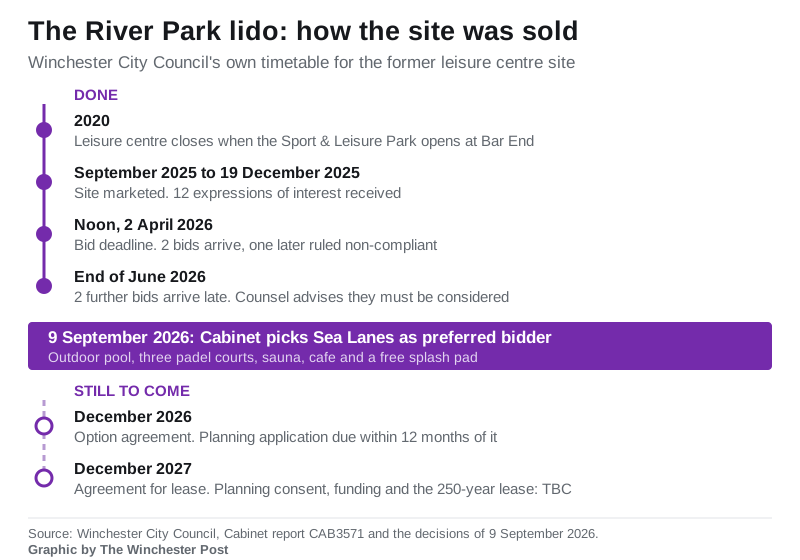
The leisure centre closed in 2020, when the Winchester Sport & Leisure Park opened at Bar End. It has been empty for six years.
Only one bid met the council’s own deadline
The marketing ran from September 2025, and 12 organisations registered an interest by 19 December 2025. They wanted to build a care home, a church, a music venue, an indoor football centre, a primary school, several padel and pickleball centres, and a fitness club with a lido.
All 12 were invited to bid by noon on 2 April 2026. What happened next is set out in the Cabinet report, CAB3571, and the council’s news release does not mention it:
- Two bids arrived by the deadline. The report says a number of parties dropped out after reviewing the site’s constraints and planning context.
- One of those two was ruled non-compliant and withdrawn from consideration.
- Two more bids arrived at the end of June, nearly three months after the deadline.
The council took King’s Counsel advice on whether it could ignore the late bids. It was advised that section 123(2) of the Local Government Act 1972 “requires the authority to consider the highest bid received, regardless of any timetable set”. So the two late submissions were assessed alongside the single compliant one, on the same criteria.
That means exactly one bid for the site both arrived on time and complied with the rules the council set.
The highest offer was turned down
The bid that offered the most money was not the lido.
The council anonymises the losing bidders as B and C. Bidder C proposed an indoor racquet sports destination with padel and pickleball courts, a coaching academy, wellness facilities and a roof terrace, alongside a family aparthotel of roughly 120 rooms. It ranked first on price.
It was rejected on two grounds:
- Planning. About 35 per cent of the scheme was accommodation, which the report calls “a significant departure from the Local Plan allocation”.
- The 1902 indenture. The freehold was bought by the council’s predecessor in 1902 “for the purpose of a Public Park and Recreation Ground”, and carries a single restrictive covenant: nothing may be built on it that amounts to “Industrial Dwellings”. Legal advice to the council was that a hotel or aparthotel use may breach it.
Officers called that bid “the highest-risk option in planning and legal deliverability”, and concluded it was “overly optimistic and incapable of actual completion in the Council’s timescales”. Clearing the covenant, the report says, could mean readvertising the whole disposal.
Only after discounting it did Sea Lanes become both the highest price on the table and, in the council’s judgement, the best consideration.
The quality scores across the three bids, marked from 0 to 5 on each criterion, were:
| Criterion | Bidder A (Sea Lanes) | Bidder B | Bidder C |
|---|---|---|---|
| Deliverability and programme | 4 | 2 | 1 |
| Experience and track record | 4 | 3 | 2 |
| Planning policy compliance | 4 | 2 | 1 |
| Social value benefits | 5 | 2 | 2 |
| Environmental benefits | 3 | 0 | 3 |
| Economic benefits | 4 | 3 | 4 |
| Total | 24 | 12 | 13 |
Bidder B, a 12-court indoor padel centre with a bistro, scored zero on environmental benefits. The report says it provided “no meaningful assessment of sustainability impacts”.
The council’s own consultant advised caution on the lido
Winchester commissioned Max Associates, a leisure consultancy, to test what each bid would do to the Sport & Leisure Park at Bar End. Its verdict on the winning bid was not warm.
Max Associates found “there is no strategic need for additional significant water provision” in Winchester, and advised: “Do not progress with Bidder A without further legal and commercial review due to the higher risk of aquatics displacement and potential contract challenge.” It also judged the bid’s costs to be below its own benchmarks.
Officers pushed back in the report, on both points:
- On demand, they record that Sea Lanes and the Lido Group argue Winchester has no outdoor swimming at all, so the lido answers a different gap.
- On cost, they say the figures were compiled by a professional cost consultant, MacConvilles, and that after clarification they are satisfied the estimates stand. Their main worry was demolition costs.
- On the legal risk, they say counsel advised that the operator of the Sport & Leisure Park has no claim over a competing facility as long as the council is not a “sponsoring authority”.
What it could do to the Sport & Leisure Park
The Sport & Leisure Park is run by Sports and Leisure Management Ltd on a contract of 15 years and 10 months, running to 2036.
Max Associates identified casual swimming as the exposure: displacement “particularly during warmer summer months, school holidays and peak leisure periods”, with swim-only memberships also at risk. Crucially, it found the impact “could begin when the new facility opens and is therefore not limited to 2036”. Under its high-impact scenario, the report says, “the effect on WSLP could be considerable”, and the terms the council can get at the 2036 retender may not match what it has now.
There is a twist in the arithmetic. Once that potential loss at Bar End is counted, Bidder B moves into second place financially. The council took legal advice on whether to count it, and was told it should not, because the Sport & Leisure Park is not part of the site being sold.
There is no cheque up front
The report is blunt about the money: “The financial offer of the preferred bid does not provide an up-front premium.” Earlier reports had raised the prospect of a capital receipt from the site.
What the council does get is an end to the holding costs:
- Maintaining and securing the empty building is budgeted at £40,000 a year, and passes to the lessee.
- A £2m provisional demolition budget is freed up for other capital projects or to cut the council’s borrowing costs.
- £130,000 has already been spent on marketing, surveys and evaluation, from a budget approved in July 2025. No more is being asked for.
If the deal collapses, the fallback is still there: demolish the building and grass the site over, at an estimated £1m including contingency.
The hurdles before a spade goes in the ground
Nothing has been granted yet. The site carries a demanding set of constraints, all of which Sea Lanes must answer at planning stage:
- Flood risk. The site sits in Flood Zone 3, next to the River Itchen, with groundwater less than a metre below the surface. A site-specific flood risk assessment, flood compensation measures and Environment Agency consent are all in prospect.
- Archaeology. Hyde Abbey Gardens, and the remains of the Benedictine abbey, extend into the leisure centre’s car park and grounds. Hyde Abbey Gateway and the adjoining bridge are scheduled monuments and Grade I listed.
- Setting. The western boundary abuts the Winchester Conservation Area, and the site sits next to the South Downs National Park with views of the cathedral.
- The masterplan condition. Local Plan Policy W10 requires any application to be preceded by, and consistent with, a site-wide masterplan for the whole site agreed with the council after engaging stakeholders.
- Access. Vehicles reach the site only from Gordon Road, off Hyde Abbey Road, both residential streets.
The council also lists local government reorganisation as a project risk, with the mitigation recorded as timescales “aligned to enable Winchester City Council Cabinet decision”. Our piece on Winchester’s city status and the parish council question covers what reorganisation would mean for the council itself.
What residents said, and when they were asked
The council ran three engagement rounds, and the numbers are worth recording because they shaped the scoring:
- 26 June 2025. Over 100 people came to the Guildhall, and 993 feedback responses were received in total. The report says there was “overwhelming support” for keeping the green space, the skate park and the indoor bowling green, and that the common themes for the site were a lido, community hubs, a cultural venue and family leisure.
- 27 January 2026. Over 250 people attended, and 757 responses came in on the day and online. That feedback was passed to bidders through the marketing agent.
- 3 September 2026. A drop-in session on the evaluation, six days before the decision.
The winning bid also carried a petition of more than 3,100 signatures for a lido, and a letter of support from the Lido Group. That evidence is why it scored 5 out of 5 on social value, the only top mark awarded to any bidder on any criterion.
Separately, the council had to advertise its intention to dispose of land forming part of an open space, under section 123(2A) of the 1972 Act. The notice ran on 4 June and 11 June 2026, with a deadline of 2 July. No objections were received.
What it means for you
- Nothing changes on the site yet. There is no planning application, and the building stays shut and fenced in the meantime.
- Your say comes at the planning application, which will go through the normal public consultation. Sea Lanes has 12 months from the option agreement to submit it, and the council expects the option agreement in December 2026. We track new applications on our Winchester planning news page.
- The skate park, the bowls club and River Park green space are not being sold. They sit outside the disposal boundary, and the report commits to keeping public access through the footways on all four sides.
- If you swim at Bar End, the council’s own consultant expects casual swimming to be where a lido bites hardest, in summer and the school holidays.
- Do not expect it soon. On the council’s own timetable the agreement for lease is not due until December 2027, and the dates for planning consent, funding and the lease itself are all recorded as “TBC”.
How this site got here
Cabinet agreed in November 2021 to lease the site to the University of Southampton for 150 years, to extend the Winchester School of Art campus (agenda item, 23 November 2021). The university decided in March 2025 not to invest, and the council restarted the search that July. Commercial agents were appointed in November 2025 (Winchester City Council, former leisure centre site).
Frequently asked questions
Is the Winchester lido definitely going ahead?
Not yet. Cabinet has chosen Sea Lanes as its preferred bidder and agreed the shape of the deal. The lease depends on Sea Lanes getting planning permission and confirming its funding, and the council’s report records both as conditions of the agreement for lease.
Where would the Winchester lido be?
On the site of the former River Park Leisure Centre, off Gordon Road, between River Park and the University of Southampton’s Winchester campus. The disposal covers the closed building and part of its car park, about 1.75 acres.
Will the skate park and the indoor bowls club close?
No. Both sit outside the land being disposed of, and the Cabinet report commits to keeping them, along with free public access to the green space at River Park.
How big would the pool be?
The bid describes a heated outdoor pool of 50 metres, open all year, with a sauna, three outdoor padel courts, a cafe and restaurant and a free splash pad. The final design is settled at planning stage, not now.
When would it open?
The council has not published an opening date. Its own timetable runs to an option agreement in December 2026 and an agreement for lease in December 2027, with planning consent, funding and the signing of the lease all recorded as to be confirmed.
Sources
- Winchester City Council, decisions taken by Cabinet, 9 September 2026
- CAB3571, Former RPLC site disposal decision, Cabinet, 9 September 2026
- Cabinet agenda and papers, 9 September 2026
- The Scrutiny Committee, 7 September 2026, which considered the report before Cabinet
- Winchester City Council, Winchester City Council approves Sea Lanes lido bid, 11 September 2026
- Winchester City Council, former leisure centre site
- Cabinet agenda item, a land transaction in respect of the River Park Leisure Centre site, 23 November 2021
Exempt appendices C to F, covering the detailed bid evaluation, the Max Associates report in full and the financial appraisal, were considered in private and are not published.
Have your say