
Inspectors dismissed 5 of 8 appeals against Winchester refusals from July to September, but allowed a Hambledon traveller site. What each decision says.
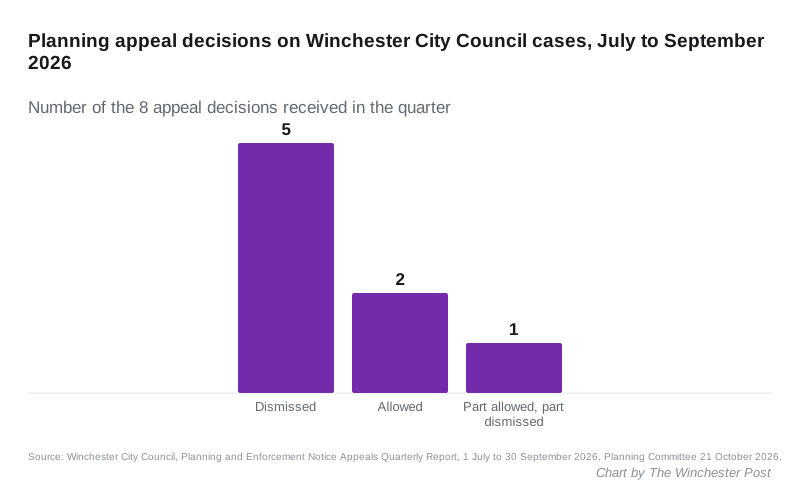
Planning inspectors upheld Winchester City Council’s decision in five of the eight appeals they ruled on between July and September. They overturned it in two, including a Gypsy and Traveller site at Hambledon, and split the eighth.
The figures are in the council’s quarterly appeals report, which went to the Planning Committee on 21 October (Winchester City Council, appeals report, July to September 2026). The committee noted it. The draft minutes record the chair thanking the planning team for “the positive appeal outcomes achieved” (Planning Committee, 21 October 2026).
All eight cases had been refused by officers under delegated powers, not by the committee. Nobody applied for costs in any of them. There were no appeals against enforcement notices in the quarter. The report covers the council’s own area and leaves out the South Downs National Park, which keeps its own records.
The two the council lost
A Gypsy and Traveller site at Lower Paddock, Bent Lane, Hambledon, about 12 miles south-east of Winchester. The application was for four static caravans, four touring caravans, two day utility buildings, bin and cycle stores, gates and fencing. It was partly retrospective.
The inspector found real harm on the council’s side:
- an unsustainable location
- harm to the rural character
- intentional unauthorised development
But the inspector also found:
- a significant unmet need for traveller pitches
- a lack of alternative accommodation
- equality considerations
- strong personal circumstances, including children’s welfare and healthcare needs
The deciding point was supply. The council could not show a five-year supply of traveller pitches, so the national “tilted balance” in paragraph 11(d)(ii) of the National Planning Policy Framework applied. Under it, permission is granted unless the harm “significantly and demonstrably” outweighs the benefits. The inspector concluded it did not.
South Wonston Social Club, Downs Road, about four miles north of the city. The council had approved a pergola over the club’s outdoor seating, replacing a temporary gazebo, but barred its use after 10pm. The inspector kept the 10pm limit from Sunday to Thursday and moved it to 11pm on Fridays and Saturdays. The council’s other conditions, on lighting details and protecting a nearby holly tree, were upheld.
The five the council won
- A rear dormer on a terraced house in Hyde Abbey Road, in the Winchester Conservation Area. The inspector found it would take out most of the original rear roof slope and look “top-heavy”, breaking up the line of the terrace’s roofs.
- Cutting back two protected sycamores at Stoney Court, off Stoney Lane. The owners wanted 5 to 6 metres off the height. The inspector called that severe and said there was not enough evidence to justify it, given the trees had been pruned before.
- An oak-framed orangery on a listed cottage on Mayles Lane, Knowle, about 11 miles south-east, refused under both planning and listed building consent. The inspector found it bulky and too contemporary, causing “considerable” harm to the listed building. That is two of the five.
- Enlarging a worker’s flat at Wortley Lodge, Bighton, near Alresford, and loosening the condition tying it to an employee so a family member could live there. The inspector found the extension went well beyond what the original permission intended, in a countryside location where a new home would conflict with local plan policy.
The split decision
Signs on a ground-floor unit at Mead House, City Road, in the city centre. The inspector refused the fascia sign and its illuminated logo as incongruous in the conservation area, but allowed the hanging signs and the window vinyls.
Since the report: a Durley enforcement case
The council has had a further result since the quarter closed. On 21 October it said an inspector had dismissed two linked appeals over land at Durley Brook Road, Durley, upholding its enforcement notice (Winchester City Council).
The inspector found the unauthorised residential use of agricultural land would harm the countryside. The owner now has six months to end that use and remove an unauthorised tennis court and other development. That case will appear in the next quarterly report.
What it means for you
If you are planning work on your home, these decisions show where inspectors are drawing the line in Winchester:
- Conservation areas: a full-width box dormer on the back of a terrace is still likely to be refused, even when it cannot be seen from the street.
- Protected trees: heavy cuts need evidence. Photos of failed branches, a tree surgeon’s report and a history of earlier pruning all count.
- Listed buildings: extensions need to look subservient to the old building, not just well built.
- Countryside homes: conditions tying a dwelling to a job are hard to loosen.
An appeal costs nothing to lodge, but five of the eight on Winchester cases this quarter failed outright. If you are a neighbour, the time to have your say is while the council is considering the application. Our Winchester planning news page explains how to find and comment on applications near you.
Sources
- Winchester City Council, Planning and Enforcement Notice Appeals Quarterly Report, 1 July to 30 September 2026, Planning Committee 21 October 2026
- Planning Committee, 21 October 2026, agenda and draft minutes
- Winchester City Council, Planning Inspector backs Winchester City Council’s enforcement action, 21 October 2026
Have your say